Quality Controlled PV
Independent quality testing by TÜV Rheinland
Qcells participates in the “Quality Controlled PV” programme of the independent certification institute TÜV Rheinland.
As part of the programme, solar modules from mass production are subjected to testing beyond standard approval certification, including testing based on IEC TS 63209, the “Extended Stress Test for PV Modules”. Materials and component suppliers are also monitored.
The “Quality Controlled PV” programme provides independent verification of defined safety and quality criteria for Qcells solar modules.
1. Extended Stress Test in line with IEC TS 63209
This series comprises more than 40 individual tests designed to assess the performance and durability of our solar modules. Testing is carried out before series production and following product changes in accordance with the applicable test requirements.
2. Continuous production monitoring
To monitor product consistency, we regularly carry out spot checks on our production lines. In addition, TÜV Rheinland monitors Qcells quality and testing measures at Qcells production sites as part of the Quality Controlled PV programme.
3. Component and material tests
Using specialised analysis methods, we regularly check particularly critical components and materials upon receipt in order to identify quality fluctuations at an early stage and prevent affected materials from entering production. These checks can also help identify potential issues that may not be detected through climatic chamber testing alone.
Our test scenarios
Our aim is to support the reliability and long-term performance of our solar modules through comprehensive testing. As part of this approach, we participate in TÜV Rheinland’s three-part “Quality Controlled PV” testing programme.
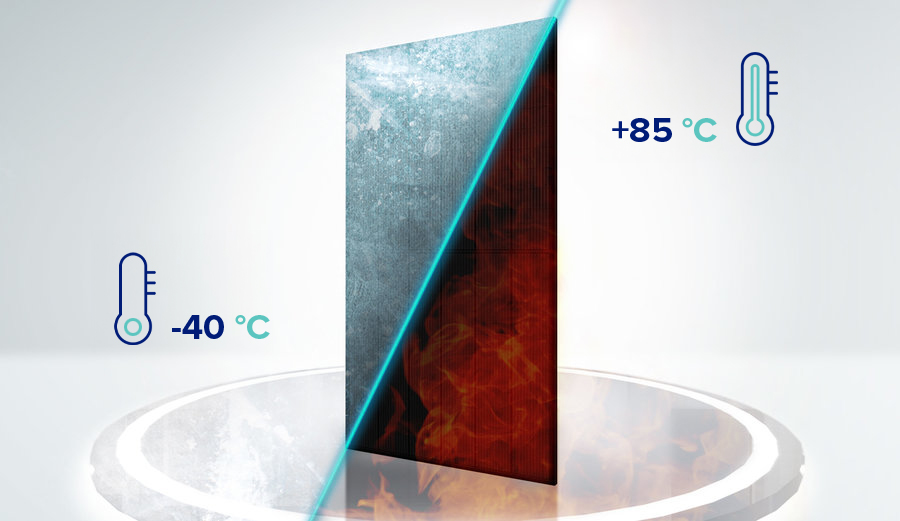
TC 600: 600 temperature cycles from -40 °C to +85 °C
Qcells solar modules undergo 600 temperature cycles between -40 °C and +85 °C over a period of 15 weeks. This represents three times the number of cycles specified in the IEC TC 200 test. The test is designed to assess the durability of solder joints and other module components under repeated temperature stress.
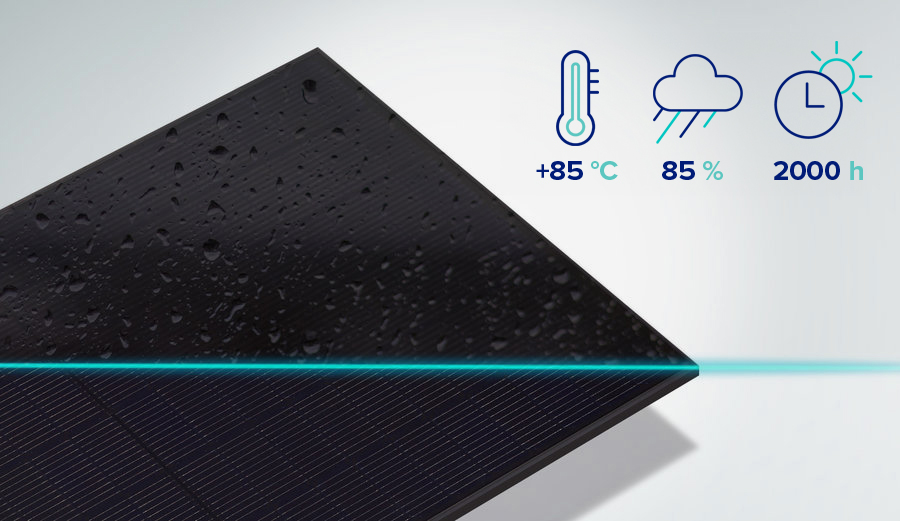
DH 2000: 2,000 hours in the climate chamber
Qcells solar modules are tested for 2,000 hours in a climate chamber at 85 °C and 85% relative humidity. This is twice the test duration specified by the corresponding IEC certification requirement. The test is designed to assess module durability under prolonged heat and humidity and to identify potential material weaknesses at an early stage.
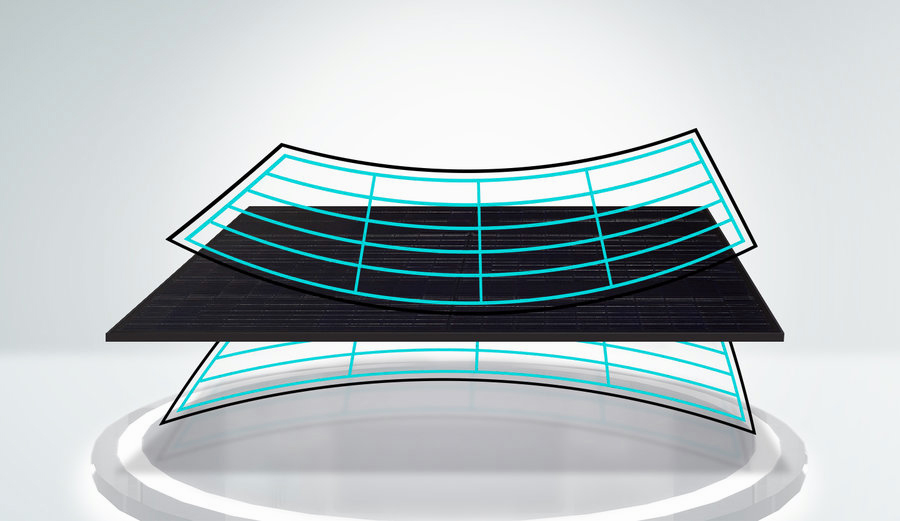
Load and degradation tests
Our solar modules undergo a range of mechanical and environmental tests to assess their reliability and durability. These include laboratory tests for mechanical loads caused by wind and snow, as well as climate chamber tests under warm and humid conditions (85 °C / 85% humidity) to assess the long-term resistance of the plastics used.
Temperature cycling between -40 °C and 85 °C is used to test the reliability of solder connections within the module. Additional reliability tests, including PID and LeTID testing, are also carried out.
Various climate chamber tests are performed in defined sequences based on current scientific findings to assess module performance under different environmental stresses over time.
TÜV Rheinland monitoring at production sites
TÜV Rheinland employees monitor Qcells solar modules at production sites through random sampling. They also witness certification tests at Qcells module test centres in Germany, Korea, Malaysia and China, selecting samples and monitoring the testing procedures.
Scheduled random sample selection
To support regular monitoring of our solar module production, the TÜV Rheinland employee assigned to the relevant production site regularly selects random samples for testing according to defined criteria. This process helps ensure that product types are tested consistently across production sites worldwide.
Random sampling of materials
Materials from our suppliers that are classified as critical for durability, performance and safety are tested through random sampling upon receipt and regularly during production. This includes plastic components whose properties may change over time.

Supplier audits
We regularly assess material and component suppliers for critical components using a defined audit programme, with particular attention to reliability, material properties and supplier change control.