Social engagement
A company active in an industry which focusses on sustainability has a special responsibility. We wish to embrace such a responsibility by supporting social commitment initiatives.
Making a difference with social commitment
A company active in an industry which focusses on sustainability has a special responsibility. We wish to embrace such a responsibility by supporting social commitment initiatives.
In July 2009, two Hanwha Qcells technicians taught 25 college students in Addis Ababa the basic principles of solar cell physics and production.
In November 2009 and November 2011, two Hanwha Qcells employees travelled to Ethiopia once again to train 25 solar technicians in Rema and Hawassa. Since 2007, Hanwha Qcells has provided patronage for the International Solar Energy School in the country, which is managed by the Solar Energy Foundation. The two Hanwha Qcells technicians arrived with solar cells, measuring devices, cables, soldering irons and comprehensive visual aids relating to photovoltaics and successfully taught the basics of solar electricity generation theory and practice within one week. After completing their training, the ‘Rural Solar Energy Managers' trained through this support programme now work in solar centres across the country, where they offer financing, installation and maintenance of small rooftop systems.
In a country where less than one per cent of the population has access to electricity, solar power, stored in a car battery, makes a huge difference by providing electric light. Solar electricity allows people to read, sew, cook, draw and listen to the radio after dark. Progress is thus being achieved.
Since 2012, Hanwha Qcells has been assisting in a construction project to provide a solar-powered water supply system to the Ethiopian mountain village of Rema. The old diesel-powered generator that used to pump the water from the well in the valley to the mountain village had broken down in autumn 2011. Ever since the people of Rema had to walk on foot scrambling an altitude of 400 m to get fresh water. In addition to supplying solar panels, Hanwha Qcells collected 8.000 € from an in-company donation to help install a solar-powered water pump. The Qcells solar modules will make the water flow uphill again.
The Solar Energy Foundation´s principal aim is to promote development aid. This primarily involves combatting proverty through the use of environmentally friendly technology. The foundation also seeks to promote environmental protection, education and training. It runs solar electrification projects in Ethiopia under the slogan "Light for education" and maintains a school for solar technicians in Ethiopia. Hanwha Qcells supports the foundation's work with financial contributions and by sending trainers to Ethiopia.
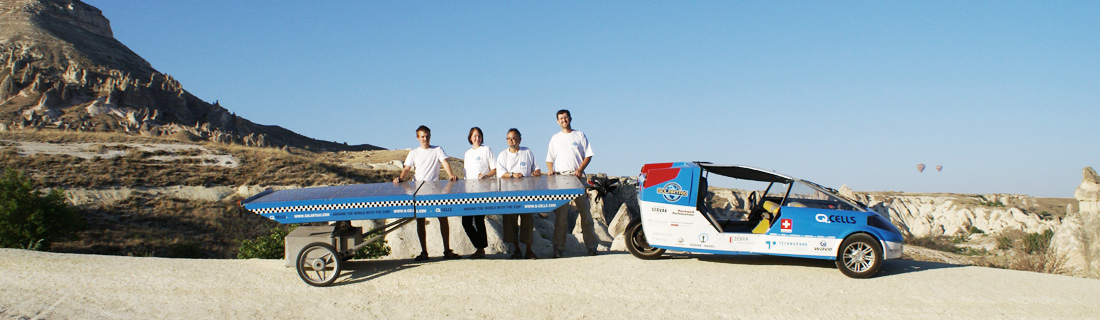
We were very much inspired by the Swiss adventurer and climate activist Louis Palmer’s idea of traveling around the world using solar energy, because it shows how solar mobility is possible in the future. That's why Hanwha Qcells is supporting the Solartaxi on its journey around the world, during which it will pick people along the way and give them a lift, thereby promoting the use of solar energy.
Fairness, Training And Responsibility
Fairness, training and responsibility are corporate values that we take as seriously as we do as performance, efficiency rates and quality.
Fairness, training and responsibility are corporate values that we take as seriously as we do as performance, efficiency rates and quality. We use international standards to guide us, such as the Universal Declaration of Human Rights by the United Nations, the European Convention for the Protection of Human Rights and Fundamental Freedoms and the principles of the Global Compact of the United Nations.
Knowledgeable, committed and motivated employees are the basis of our success. That’s why we attach great importance to our employees’ expertise. In 2013, a total of 689 employees took part in 169 training events and 3,523.25 hours of training. This included legal training for managers as well as the training of auditors.
Qcells had contracts for a total of 33 trainees and students in four training programmes and three student programmes in 2013. Students receive optimum grounding for a successful start to a career in the solar industry in the twelve outstandingly equipped specialist study rooms at our in-company training centre. One of our trainees was awarded the prize for the best machine and systems operator by the Halle-Dessau District Chamber of Commerce and Industry in November 2009.
Our social responsibility extends to initiatives far beyond the region, as can be seen from our involvement in the Solar Energy Foundation.
In cooperation with charitable organization Diakonieverein e.V. Bitterfeld-Wolfen-Gräfenhainichen, we carried out an advanced training project with five young mentally and multi-handicapped people in 2010. One of our trainers taught participants how to use calculation and text editing programs at our in-company training centre, aided by business administration trainees.
Our employees are increasingly focussing on finding a balance between their career and family life. Employees shouldn’t need to choose between a child and a career. We'd like them to combine the two, so that our employees are able to fulfil their personal and professional responsibilities in equal measure. Depending on the job and place of work, we thus offer a range of different working-time models, such as trust-based working hours, flexitime and a one-year extension to parental leave involving part-time employment and telecommuting from home. In 2010, we set up a day-care centre near the company with 20 places for our employees’ children in cooperation with the town of Sandersdorf-Brehna.
Establishing organisational regulations has enabled us to create the required conditions for Hanwha Qcells to also lead the way in company healthcare and work safety in terms of quality and performance. It is our strategic goal:
1. To ensure that Hanwha Qcells employees are healthy and fully fit for work and that no work accidents or occupational diseases occur (target = zero)
2. Our machinery and equipment are scrutinised with regard to their safety-related layout, safe operation and minimisation of impact due to breakdowns thanks to organisational hazard prevention measures.
This allows us make use of our machinery and equipment in line with the latest safety engineering standards when planning, setting up, operating and shutting down our equipment and machinery.
Social engagement in the region
Hanwha Qcells supports initiatives and associations in the Bitterfeld-Wolfen region and provides assistance to sports clubs and their youth work. These projects take on an important role in social cohesion and political education in the region. They also support the political work involved in attracting new investors.
The ‘Solar energy goes to school in Sachsen-Anhalt’ project was initiated by Magdeburg-based engineering company MUTING and the Sachsen-Anhalt Ministry of Science and Economic Affairs. Hanwha Qcells, solar system provider Mp-Tec and engineering services company Technik Centrum Thale financed photovoltaic systems and information material for lessons at 20 schools. The primary objectives of the project are to interest children in future energy supply issues, educate them with a particular focus on the environment and show them career options in the forward-looking photovoltaics industry. The project receives further support from the Ministry of Agriculture and the Environment, the Sachsen-Anhalt Ministry for Culture and the European Social Fund.
Hanwha Qcells donated 25 mini-photovoltaic modules, accompanying ammeters and displays for use in lessons. The mini-modules allow teachers and pupils to visualise solar electricity generation in an experiment and thus include the subject of photovoltaics and renewable energies in the timetable.